UIA Books · English Edition
For people who manage their own capital
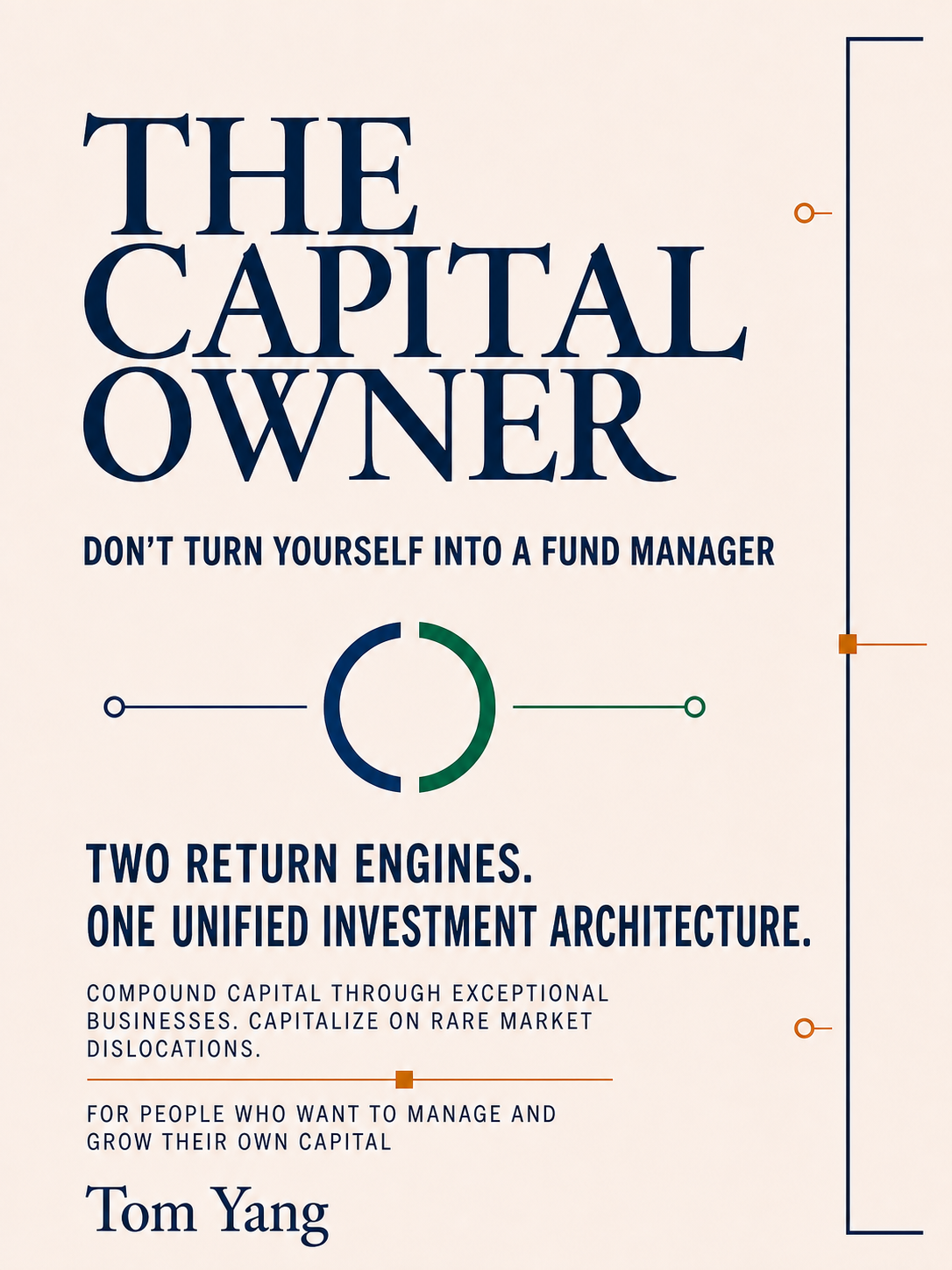
The Capital Owner
Don’t turn yourself into a fund manager.
A book about where investment returns actually come from—and how an owner can align judgment, time, risk, and action with the nature of their own capital.
- Format
- EPUB ebook
- Price
- US$9.99
- English Edition
- UIA Institute Inc.
Digital ebook · One-time purchase. Final sale after digital delivery, except where required by law or otherwise approved by UIA.
Why this book exists
Investing offers an endless supply of methods, indicators, and polished explanations. The harder question comes first: what is expected to create the return, and what kind of capital is being asked to earn it?
The Capital Owner begins with that causal question. It removes methods that cannot state their source of profit, separates capital with different jobs, and asks what an owner must be able to endure when judgment and price diverge.
A drawer full of tools cannot substitute for a clear map of the ground.
Owner Capital Is Different
Institutional practice can be rigorous and entirely rational—inside the contract it was built to serve. Owner capital has another objective function, another clock, and another form of accountability.
Entrusted capital
A permitted path matters
Owner capital
The right to wait
Responsibility
Freedom is not an exemption
Two Sources of Return
The book reduces equity investing to two sources the owner can name before capital is deployed. They may involve the same company, but they cannot share the same lifecycle.
Two return engines, two clocks, one owner-capital architecture.
A road
Long-Term Compounding
A mostly closed doorway
Market Dislocation Trading
What the Reader Will Build
Not a list of trades. A way to assign each decision a source of return, a capital role, and a standard of evidence.
- Distinguish business value creation from the repair of mispricing.
- Separate owner-capital objectives from the visible habits of client-capital managers.
- Define risk through permanent consequence, not volatility alone.
- Keep long-term ownership and tactical repair positions from borrowing each other’s reasons.
- Use price, patience, instruments, and exits in service of a clearly named task.
- Turn principles into a reviewable operating discipline without surrendering judgment to a tool.
From one book to a working architecture
The book establishes the reasoning. UIA gives it places to be tested.
The Capital Owner is the entrance, not the endpoint. It names the sources of return and the responsibilities of owner capital; the public UIA system then connects those ideas to continuing research, observation, and review.
01 · The book
English Edition
Begin with the source of return
Read the argument in causal order: what can create profit, what owner capital can do differently, and what evidence each investment path must earn.
02 · The unified architecture
Keep two return engines distinct
One owner can use both paths without asking them to share the same reason, clock, evidence, or exit logic.
First return engine
Long-Term Compounding
Second return engine
Market Dislocation Trading
03 · Public UIA
Move from explanation to observation
Each public destination has one clear job. Together they extend the book without turning it into a product manual.
A continuing path from reading to review
- 01 · Read
Begin with the sources of return, the nature of owner capital, and the meaning of risk.
- 02 · FrameUse the System to see how the two paths remain unified without losing their separate rules. ↗
- 03 · ExamineUse Research to understand why a conclusion is supported and where its limits remain. ↗
- 04 · ReadUse the Library to follow Core Research and thematic essays shaped by the UIA research method. ↗
- 05 · ApplyUse the Workstation to examine an asset through the appropriate research responsibility. ↗
- 06 · Review
Return to the original objective, evidence, and invalidation conditions; refine the decision without rewriting its identity.
The book is not a UIA product manual. The investment operating system appears near the end because it is the consequence of the argument, not its premise.
Contents
The complete published structure of the English edition: four parts, eighteen chapters, a conclusion, and four practical checklists.
- Preface — Why I Ended Up with Only Two PathsFree Sample
Part I — The Foundations of Owner Capital
- Chapter 1 — Where Investment Returns Actually Come FromFree Sample
- Chapter 2 — When I Thought Tools Were the Answer
- Chapter 3 — Don’t Turn Yourself into a Fund ManagerSelected Sample
- Chapter 4 — What Risk Really Means
- Chapter 5 — Two Paths for Owner Capital
Part II — Long-Term Compounding
- Chapter 6 — What Is Truly Worth Owning for the Long Term
- Chapter 7 — Eliminate the Wrong Businesses Before Choosing the Best
- Chapter 8 — A Great Business Is Not a Buy at Every Price
- Chapter 9 — Concentration Is Not a Mathematical Formula
- Chapter 10 — The Hardest Part of Long-Term Ownership
Part III — Market Dislocation Trading
- Chapter 11 — Why Markets Must Sometimes Misprice Assets
- Chapter 12 — Why I Act Only in Assets I Know Well
- Chapter 13 — From Normal Volatility to Severe Dislocation
- Chapter 14 — Buying in a Panic Is Not an Act of Courage
- Chapter 15 — Every New Unit of Capital Must Buy New Information
- Chapter 16 — Protect the Right to Wait
- Chapter 17 — Bring the Repair Profits Home
Part IV — Turning Judgment into an Operating System
- Chapter 18 — Why an Investment Operating System Becomes Necessary
- A.1 — Long-Term Investment Decision Checklist
- A.2 — Long-Term Holding Review
- A.3 — Pre-Trade Market Dislocation Checklist
- A.4 — Post-Trade Market Dislocation Review
Who It Is For
For readers who want a serious framework for managing capital they ultimately own and answer for.
Independent capital owners
People making real allocation decisions without a client mandate or a need to look continuously active.
Long-horizon investors
Readers who want to connect business quality, price, expected return, patience, and exit responsibility.
Practitioners simplifying a crowded process
Investors with many tools who want fewer permissible actions and clearer causal attribution.
Readers studying market pressure
Those who want to distinguish ordinary volatility and justified repricing from a qualified, repairable dislocation.
The book does not promise performance, prescribe personal positions, or remove the possibility of loss.
07 · Free · No account required
Read before you decide
The sample is long enough to show the book’s voice, causal structure, and central distinction between owner capital and entrusted capital.
Open the English sampleThe sample includes
- The complete Preface
- The complete Chapter 1 — Where Investment Returns Actually Come From
- A selected beginning of Chapter 3 — Don’t Turn Yourself into a Fund Manager
08 · English Edition
The English Edition
- Format
- EPUB ebook
- Price
- US$9.99
Purchase directly from UIA
Complete a secure one-time purchase through Stripe Checkout. Access appears immediately after payment and is also sent by email.
Digital ebook · One-time purchase. Final sale after digital delivery, except where required by law or otherwise approved by UIA.Bookstore options
Only verified destinations for this exact English edition are published.
External availability and regional purchase eligibility are determined by the bookstore.